
Rayleigh Scattering in Nature and Landscape Photography
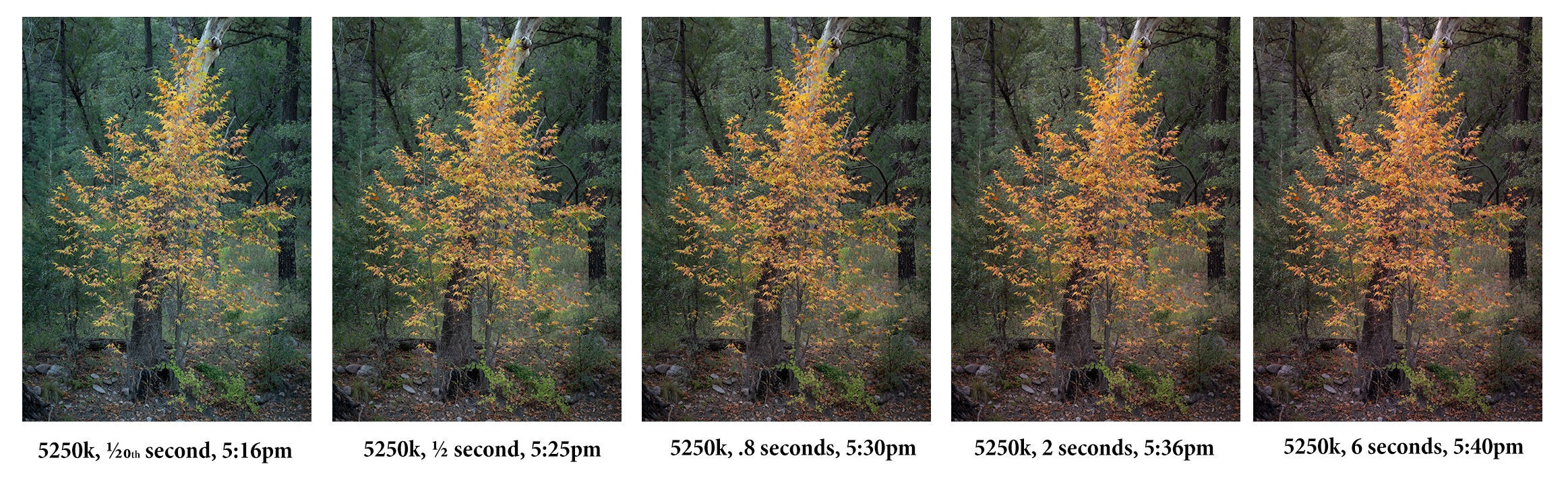
Many photographers have likely never heard of Rayleigh Scattering or considered its impacts on their own photographs. In short, Rayleigh Scattering is the scattering or deflection of light by particles with a size much smaller than the wavelength of the radiation. The amount of scattering is inversely proportional to the fourth power of the wavelength (e.g., a blue color is scattered much more than a red color as light propagates through air). The five-frame panel heading this article is an ideal example of this (note that the photographs become more red/less blue in appearance as the light disappears). Rayleigh Scattering is also why water and sky appear blue to us, even though both are transparent and colorless.
For many of us, Rayleigh Scattering is something that can be be taken advantage to create harmonious color in our photographs. The background granite cliffs in my photograph Farewell to a Season are not actually blue, yet Rayleigh Scattering provides the blue that harmonizes beautifully with other primary colors in this photograph.
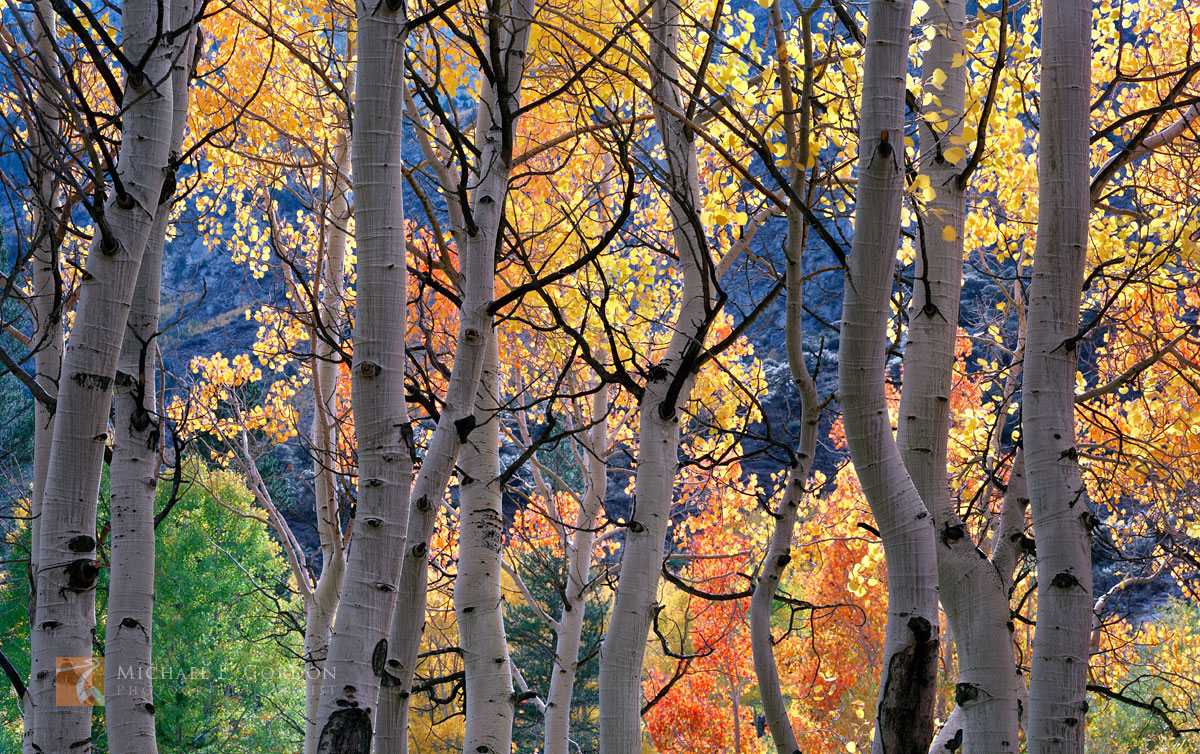
Late afternoon back-light illuminates peak autumn color in a High Sierra Quaking Aspen grove (Populus tremuloides).
Rayleigh Scattering is also what attracted me to the blue hues found in granite boulders alongside the Merced River in Yosemite Valley. Although they're gray. And had it been overcast, with little to no Rayleigh Scattering available, it's likely I would never have made this photograph of complimentary harmonious color.
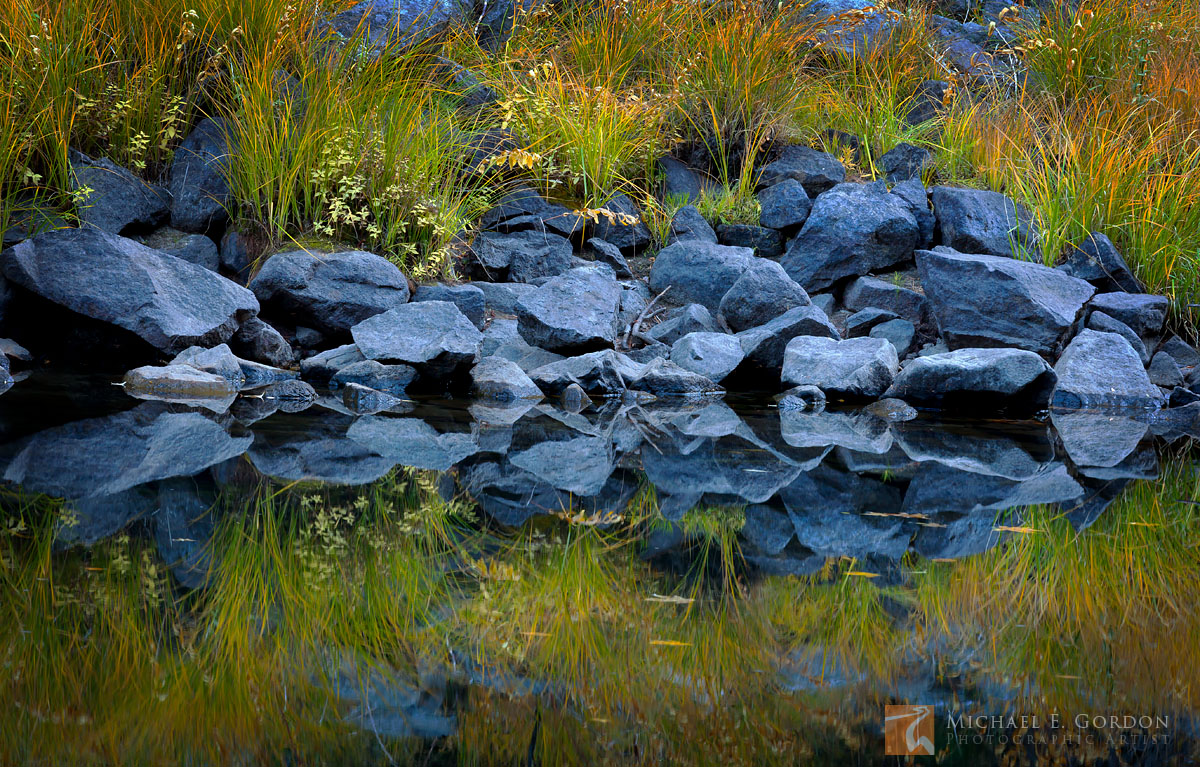
Autumn-hued grasses and shrubs and blue granite reflected in the tranquil Merced River.
Rayleigh Scattering is also what makes canyon walls appear to be blue on sunlit days even when they're gray. If you walk in this canyon only on gray days, you will never witness blue walls
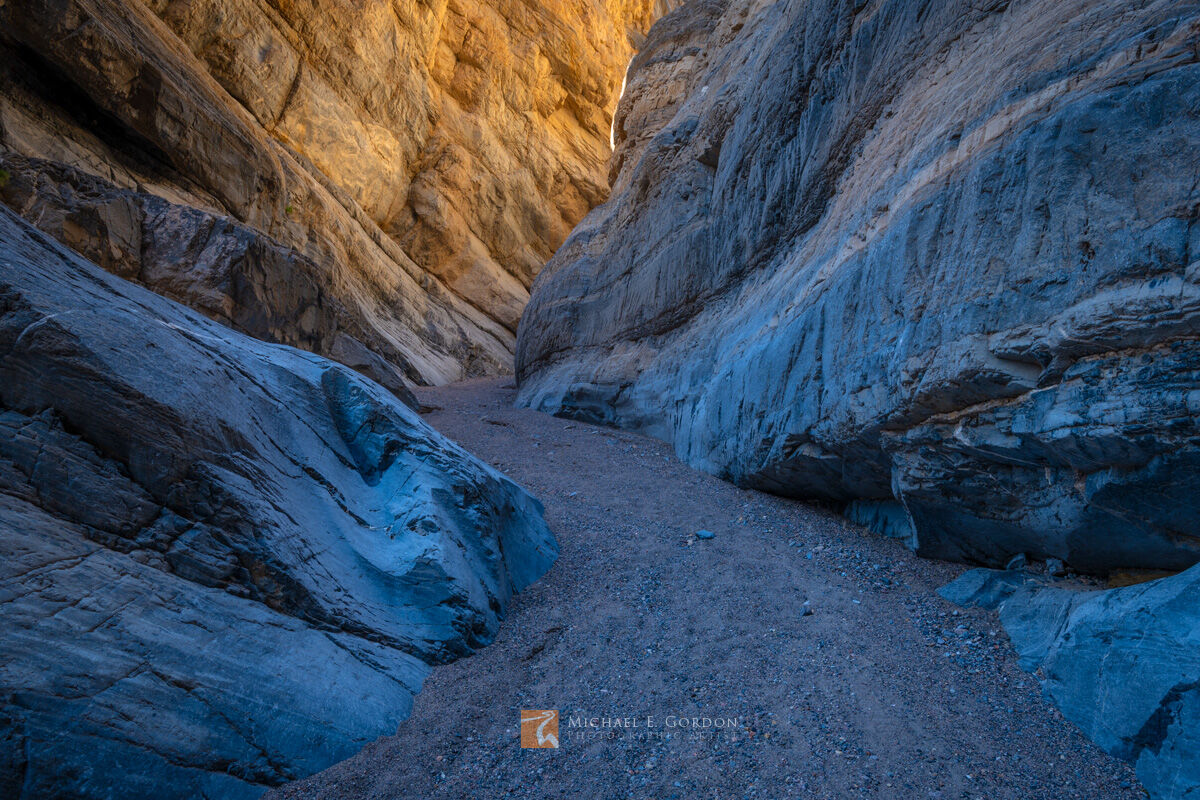
Rayleigh Scattering is also what provides the blue water complimenting green sedges and golden reflected granite in Serenity. I absolutely would have walked away from this without a photograph, had it been overcast (overcast would have blocked radiation, deflection, and the reflection, and would have wiped out the blue):
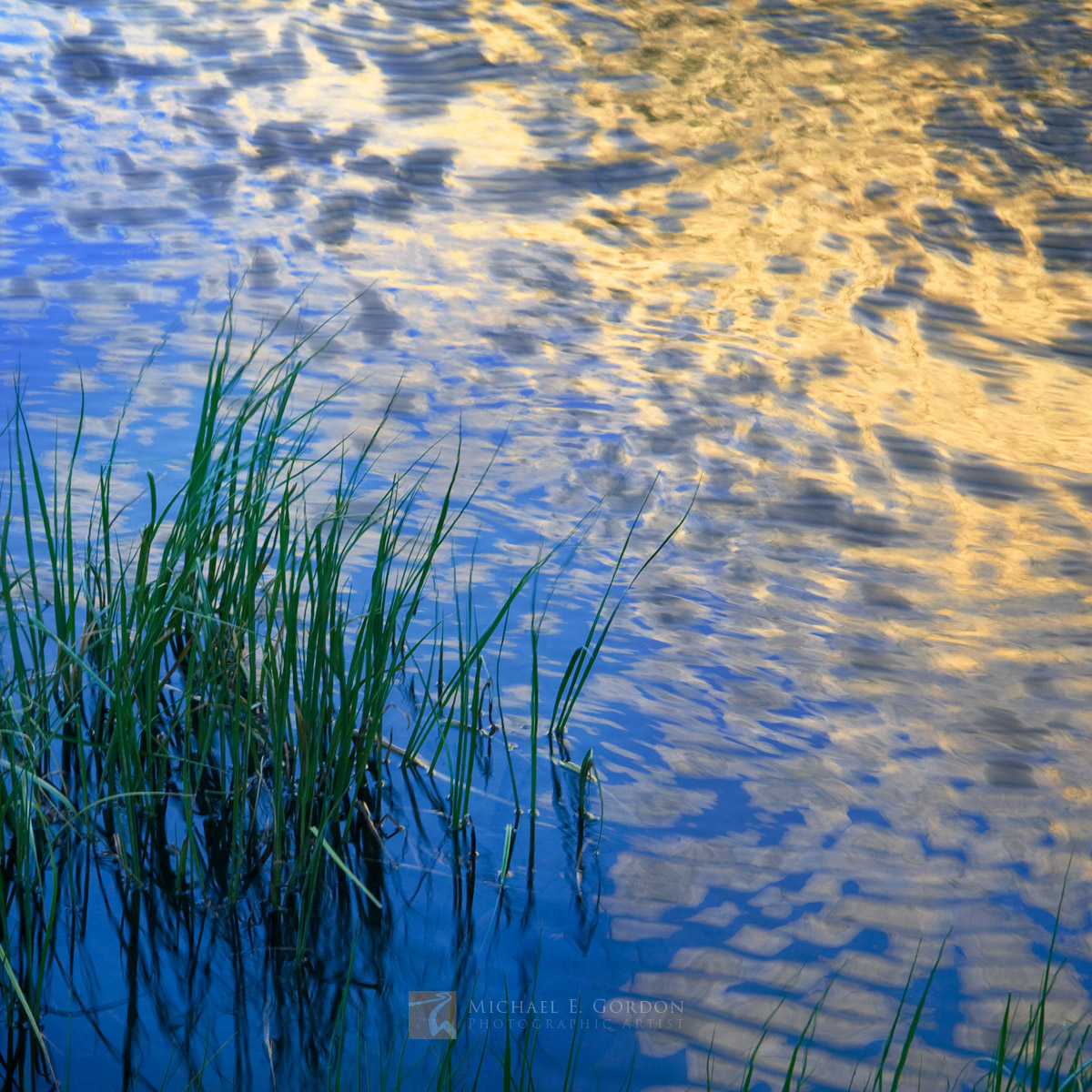
Golden High Sierra granite at sunrise reflects on a wind-rippled pond.
So let's return to the five-frame example heading this article (please click on the thumbnail image below for an ENLARGED view and more accurate color perception).
All five photographs were made on a tripod, with identical white balance (5250k, Sunny/Daylight), the same ISO (64), and same aperture (f4). The only thing that changed was the time of day and length of exposure, noted below each frame. These frames are effectively straight out of the camera, with no processing. The photographs spanned more than 24 minutes of time, from open shade (sun still up, but no direct light) to near darkness (sun down, darkness encroaching, the tree was becoming more difficult for me to see with the naked eye). The sun set on this day right around 5:30pm, the same time as the middle of the five frames. Note how the first couple of frames have an almost too-strong cyan cast, while those at the end become noticeably warmer and redder in appearance. Why would I spend more than 24 minutes photographing the exact same thing (I have more than just these five frames)? Simply because I was setting up my camp, next to a beautiful, bubbling creek, and I decided to train my camera on this opposing creekside study while I was doing so (walking over to the camera every few minutes to fire off another frame).
Note the relationships between colors in the frame; their response to Rayleigh Scattering is not linear (color relationships do not shift evenly). Which is exactly why I recommend to all photographers that they should set their cameras to Sunny/Daylight (generally about 5200k for most camera manufacturers) - this best preserves the natural order of color and their relationships. Had I set my camera to AUTO White Balance, all five frames would have looked identical, or near identical. And any native color cast that drew my attention in the first place would have been wiped out by the camera's automated color correction.
If you asked me to pick the best of the five frames to work with, which do you think I might choose? It would likely be the frame at 5:30pm, or the frame at 5:36pm. In these particular examples, Rayleigh Scattering is best controlled at these times - not too cool, not too warm - and it gives me the widest color latitude with which to work. I won't have to add excess warming, I won't have to reduce the red/warmth that infiltrates the last two frames. The middle frame gives me a good starting point from which to selectively color correct.
Of course, one can set their camera to AUTO White Balance (or something other than Daylight/5250k) and color correct their frames later, but shifts to Color Temperature or Tint/Hue in editing software would be unable to accurately render what I perceived real-time. Adding warming to the first or second frames would not instantly make them look like the fourth of fifth frames - the color relationships are altered.
Be mindful of Rayleigh Scattering. Use it to your advantage. If you are photographing subjects in open shade or waning light, be mindful that the color may be changing right before your eyes. Training yourself to see Rayleigh Scattering in any situation may sound impossible - it is not. If you have the opportunity to do a time study like I did with this Arizona Sycamore, give it a try.
Don't forget: If you want to preserve the actual color that is physically present in any natural setting, be sure your camera's White Balance is set only to Daylight/Sunny. NO camera setting should ever be on AUTO!