
Strange Worlds
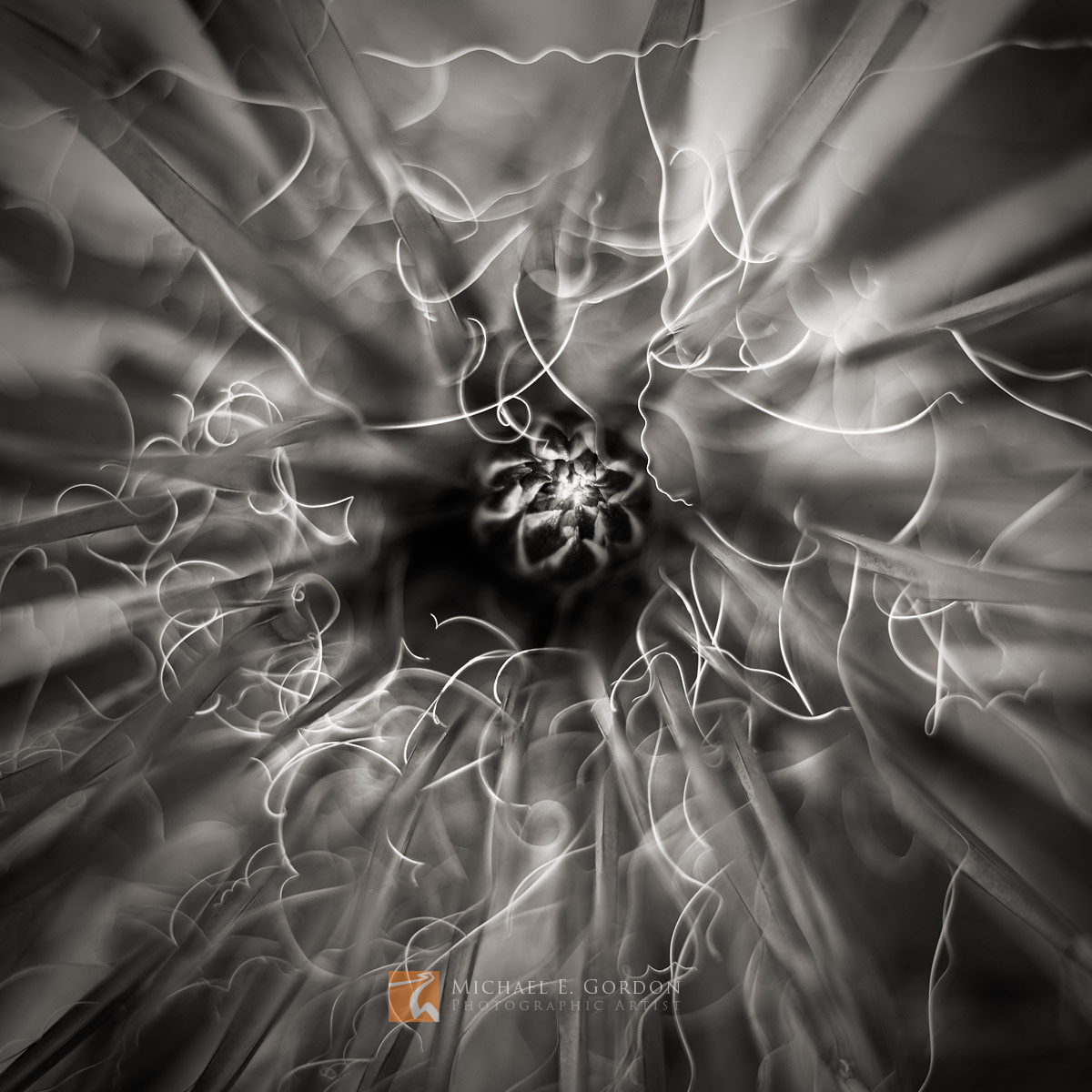
The wildly abstract filaments or threads of a budding Narrowleaf Yucca (Yucca angustissima)
resemble the arcing electricity of a Tesla Coil. Prints Available
This article was originally published in Elements Photography Magazine Issue 34. ©2023 MIchael E. Gordon, All Rights Reserved Worldwide.
A monochromatic departure from reality - not merely in subject content but in the photographic concept itself - can allow a viewer to establish a deeper and more immediate connection with the essence of the image.
“Black and white is abstract; color is not. Looking at a black-and-white photograph, you are already looking at a strange world.”
Joel Sternfeld
I was born fifteen years after the advent of color television. My earliest recollections of TV and cinema involved a mix of both black and white and color. Watching moving pictures in color represented an objective world of color and light I knew and understood as a child. But viewing virtually anything in monochrome instantly transported me to abstract dimensions of light and reality. Film Noir and Science Fiction producers of the day must have known that an era absent of color was probably the heyday for their creative offerings. Monochromatic mystery and the drama of light and shadow blended with otherworldly existentialist stories lent all the strangeness that was needed for stimulating and sometimes unnerving viewing. My favorite then and still today was Rod Serling’s original Twilight Zone (1959-1964). In its 40 second introduction, Serling reveals to us a “dimension as vast as space and as timeless as infinity. It is the middle ground between light and shadow, between science and superstition”. This Fifth Dimension, as Serling called it, this “dimension of imagination”, was one that this black and white photographer sought to capture through his photographs.
Readers familiar with my work know that it centers on America’s deserts. The “weird solitude, the great silence, the grim desolation” that author John C. Van Dyke so eloquently wrote about the desert in 1904 primed my photographic imagination. The strange and unusual plants found across the region, its vast and otherworldly basins and ranges, and its brilliant and often enigmatic light guided the way for my visions. These subjects, blended with a lifetime of adventure and experience in arid wilderness and a sometimes correspondingly wild imagination, have led me down a fascinating and continuously evolving creative path.
A monochromatic departure from reality - not merely in subject content but in the photographic concept itself - can allow a viewer to establish a deeper and more immediate connection with the essence of the image, potentially revealing emotions and narratives that are often concealed by or diminished in color. Black and white photography also possesses the innate ability to intensify emotions and drama. Stripped of color, composition and the interplay of light and shadow take center stage, which is evident in the examples that accompany this article. Stark contrasts and deep shadows can create a sense of mystery and depth, prompting viewers to engage in a more thought-provoking experience, potentially allowing them to interpret and relate to a photograph on a deeper level. The surreal quality of some black and white photography - sometimes enhanced through the use of infrared - adds to its apparent strangeness, providing a glimpse into a world that may be both familiar and foreign, blurring the line between reality and imagination. Photographs can also be dreamlike (see Illuminated), as if seen through a hazy veil of memories. Great black and white photography can be likened to a blank canvas: it allows the photographer and the viewer to project their imaginative interpretations and emotions onto the subject and the image.
To be sure, these are not the sort of images that readily find their way onto your sensor. Expanding your visual repertoire requires equal amounts of awareness, intuition, imagination, timing, and visualization. Most importantly, removing the blinders that act as obstacles to your own artistic evolution is paramount. Break your own practices and patterns. Think like an artist, not like a photojournalist. Neither you nor your photographs are under any obligation to deliver to the viewer any objective reality. An artfully made photograph should slow down the viewer and invite them to actively participate in “reading” the image. There is much more to black and white nature and landscape photography than the same old postcard views and Ansel-style conversions from color; consider the natural world as a diversified palette of unlimited opportunity for your creative explorations. Use the fullness of your creative abilities and the extended artistic liberties afforded by the medium to their fullest expressive potential.
“What use is having a great depth of field, if there is not an adequate depth of feeling?”
W. Eugene Smith
Some of the devices employed in my photographs to heighten the strange or surreal are Abstraction (I prefer pure abstraction, which may require the artist’s explanation in order to understand what’s happening in the image [see Nikola’s Fire, heading this article]; Metaphor (when the subject or elements in the image are being used as a symbols of or to symbolize things other than the subject itself [see Joshua’s Defeat]); Ambiguity (when the photograph may be open to interpretation; more than one meaning may be possible [see Shaman]); and Gesture (an unusual or lyrical stance, movement, or posture - gesture is by no means limited to human expression! [see Pirouette]).
The great Minor White suggested that “one should photograph things not only for what they are but also for what else they are.” To be clear, the aforementioned devices are not what I actively search for when I am working in the field; intuition and training have made inclusion of these concepts second nature in the creation of my photographs. Expand your knowledge and awareness of everything. The more you know - whether it’s about geology, botany, space exploration, or physics - the more you can conceptually use in the creation of your photographs. Experiment and fail. What might initially seem like a big leap of photographic faith - giving up the certainty of successful but tired formulas - may ultimately result in a substantial dose of creative epiphany.
“repetition is the key to transitioning conscious skilled work that requires cognitive effort and concentration into seemingly effortless intuition”
Guy Tal
I would like to discuss my thought process and execution behind a few of the photographs that accompany this article.
The American Dream

An abandoned shack and Joshua tree (Yucca brevifolia) in California's Mojave Desert framed by towering cumulonimbus thunderstorm cloud. Prints Available
Using new-to-me mobile/smart phone technology, I was on the hunt for a developing summer thunderstorm, a grand Mojave Desert cumulonimbus. It was by luck that radar led me to a remote valley where I found an abandoned homestead (not uncommon on the Mojave Desert) which I could force into convergence with the billowing cloud by careful camera positioning. Barren ground, a lone cluster of partially dead Joshua trees, and missing windows enhance the feelings of defeat. Total failure. The year of the photograph was 2008, the U.S. was deep in the global financial crisis, and even my own home value had tanked by nearly 60%. The American Dream ethos seemed to be slipping away from the average American (and still is). These ideas were on my mind as I worked; my title was in place before the shutter was ever released. Furthermore, this image - the first of many like it - spawned a series which is still an ongoing project.
Ghost
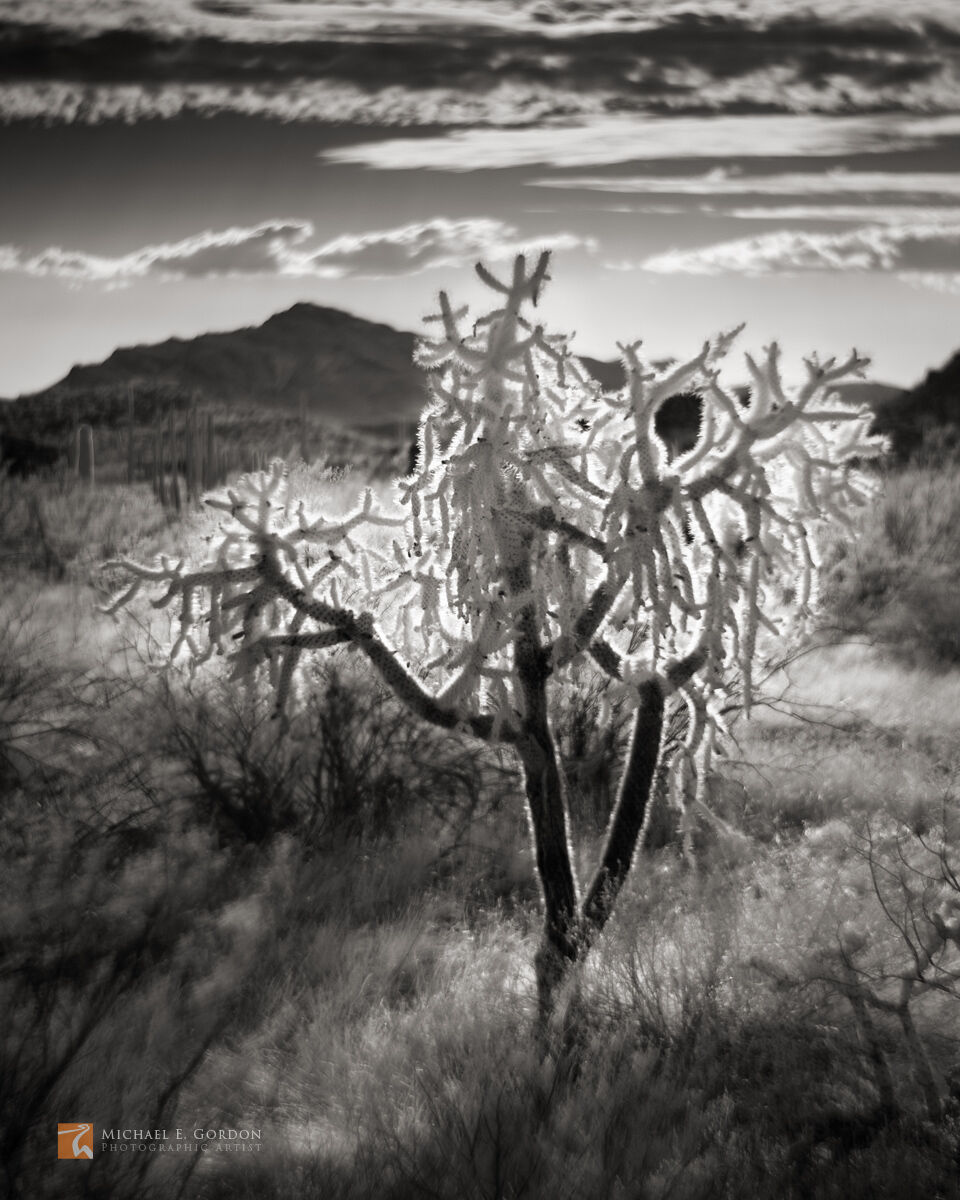
A ghostly Chain Fruit Cholla (Cylindropuntia fulgida) aglow in beautiful afternoon backlit, as the remnants of Hurricane HIlary sail by the distant Tillotson Peak. Prints Available
The Sonoran Desert is filled with many unusual plants which I am fascinated by and stimulated to photograph. These are not only highly evolved organisms adapted to arid lands, many possess bold and quirky Seussian structural qualities that I want to embody in my photographs. On this particular afternoon, my camp was surrounded by delightful desert gardens and positioned to receive the long and late light of summer. My target for the evening was the Chain Fruit Cholla cactus (Cylindropuntia fulgida), sometimes reaching towering heights up to thirteen feet (4m). There was no shortage of photogenic specimens here. But it was this one that caught my eye, its form resembling that of a ghost with its arms outstretched, the ghostliness evermore enhanced through the use of infrared. Even better, with careful camera positioning, I could combine the ghostly cholla with the distant angular pointed peak I had climbed the day before (a good climb followed by a good photograph is immensely satisfying). The brilliant backlight, the gesture of this uncommon cholla, and the use of a soft focus lens combined with my printing aesthetic, reflect a personalized and uncommon approach.
Illuminating
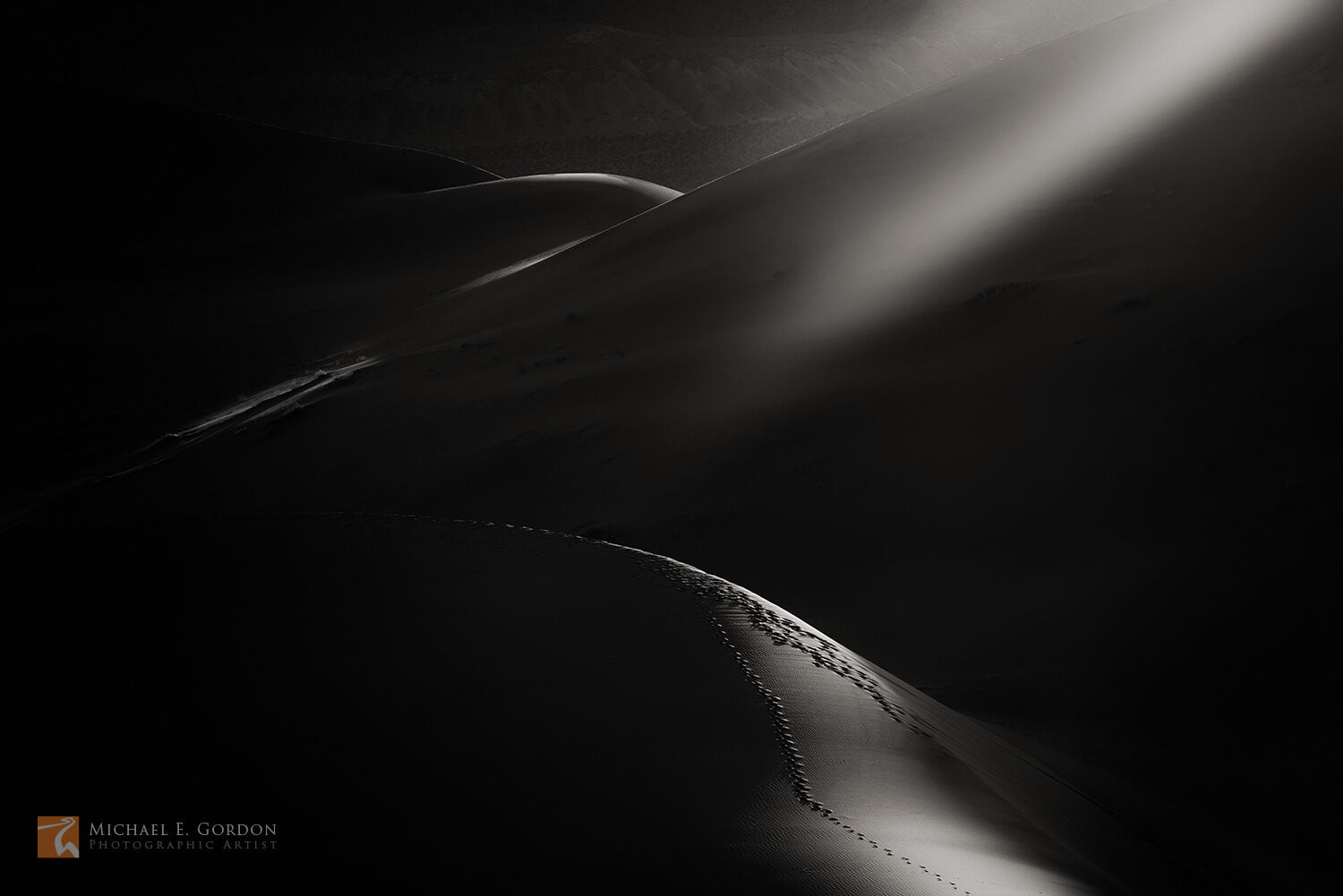
Two paths converge on the crest of a sand dune. Or do they? Do the steps lead into or away from the light? Who left them? A non-human animal(s) or human(s)? It’s awfully dark and mysterious back there; to where do the tracks lead? What’s with the strange beams of light? A photograph with accidental flare made minutes before this one but without tracks told me that flare combined with tracks could be used conceptually, to great effect, if the flare could be carefully controlled. There are no tricks employed here; it’s a single frame, exposed to protect the highlights, with carefully “leaked” flare (sans flare polygons) which resulted in a dark and mysterious look despite the plentiful light of the late afternoon hour. Additional contrast control and careful dodging and burning resulted in a not-so-common sand dune photograph.
Nature and landscape photography can do more than report on the factual and objective. Think outside the box. Be strange. Use your creativity and imagination. Be playful in your images. Take chances. Think like a great film director. Consider the back story. Pique the interest of your viewer and keep them engaged with a hook. Think like an artist.
"Trust that little voice in your head that says 'Wouldn't it be interesting if . . .’ And then do it."
Duane Michals
Please join me and the great Chuck Kimmerle for The Artful Black & White Landscape workshop in Death Valley, February 8-12, 2027, where these and other creativity topics are discussed at length.