
Free Your Mind and the Images Will Follow
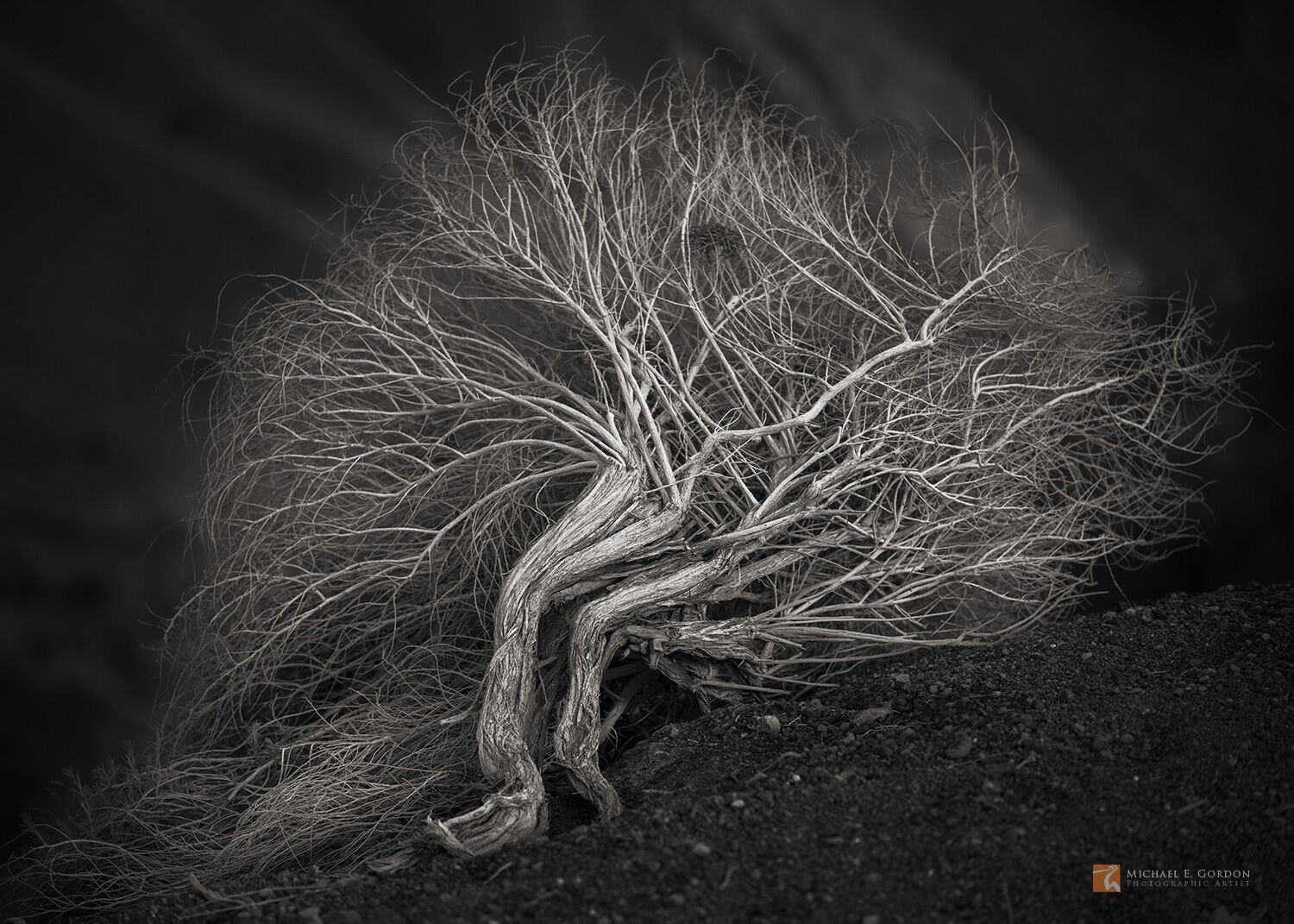
An elegant wind uprooted Cheesebush (Ambrosia salsola) on the edge of a volcanic crater.
This article was originally published in Medium Format magazine, May 2022. ©2022 Michael E. Gordon, All Rights Reserved Worldwide.
“To repeatedly approach the same subject over and over again, as Weston did with his peppers, is a method more likely to produce significant results than random image making in search of the elusive greatest hit.”
Brooks Jensen
Over the course of seventeen years of teaching the art and craft of photography - fundamentals, technical, and creativity - I have had the good fortune of working with and observing (and hopefully helping to enhance for the better) the behaviors of hundreds of photographers. If you, dear reader, have been one of my students, thank you very much! Over the last decade, the majority (by choice) of my workshops and teachings have taken place in one of America’s (if not the world’s) most stunning and diverse places, Death Valley National Park. I choose to teach here not because it is currently one of the hotter destinations for photographers, but rather because of my long standing love affair with the Park and its wealth of diverse environments found across its 5,270 square miles (which I have come to intimately know over the course of more than thirty years). If the homework of a photographer visiting Death Valley were to be based only on photos found on social media, one could easily be led to believe that options here are limited to colorful badlands, mud cracks, salt polygons, and sand dunes. In fact, the number of options for photography in Death Valley (or anywhere) are only as limitless as a photographer’s imagination (resist the false notion that it’s all been done). Perhaps it is imagination (and curiosity) that may be construed as the defining characteristic which separates landscape photography as objective appearances (this is what the scene looks like to anyone who might stand here) versus a medium for expressive art (using elements of a landscape to express personal feelings and concepts that would not be obvious to those who might stand here).
Regardless of the country, state, or biome I find myself in, my photo shoots are never less than 3-4 hours in length, and quite often even longer. No matter the place, I work the scene and often visualize conceptual narratives from various elements which often become the drivers for themes and photographs. To be sure, such a length of time is rarely a continuous sequence of exposures; much of it is often spent just watching, studying, and imagining a number of possibilities and concepts. How could I ever begin to understand how light behaves and unfolds across a particular landscape if I limit my shoot only to what I’ve perceived as the zone of usable light (which is often based erroneously on apps and their predictions)? And how would I know the extent of usable light for any given location unless I patiently wait and watch, often over the course of multiple visits? Is there a downside to quietly watching light and life unfold across a beautiful landscape? How would I begin to ever know the full extent of my creative possibilities if I had already primed my mind with preconceptions of place and with the photographs of others which I know can be found there?
As a photographer who spends many days in the field each year, here is what I most often witness (the norm, not the exception) among other workshops and photographers: when the Golden Hour has concluded (that single hour of light following sunrise and preceding sunset, predetermined by charts and app makers), the shoot concludes and photographers depart for something else presumably more important than their photography.

For both tourists and photographers alike, Zabriskie Point is one of the most popular and well known locations in Death Valley National Park. Situated on the east side of Death Valley and easily accessed by all, the 360° vista from the hilltop is stunning, encompassing a view of colorfully sculpted badlands, towering desert mountain ranges, cliffs, bajadas, and a vast saline basin. On any given morning, tourists and photographers gather in the darkness to watch a spectacle of light unfold across hundreds of square miles of stunning desert landscape. On any given morning, most of the assemblage found on the hilltop will have departed within thirty minutes of first light on Manly Beacon and the badlands. No, the light did not end nor did any shift whistle blow, but the mass exodus always suggests otherwise. At this point, my workshops and photo tour participants gain unfettered access across the entire hilltop where they continue to photograph developing light for another 90-120 minutes.
Foremost in your field practices, I want to encourage readers to slow down (way down) and to jump off whatever treadmill you are on. Treat every location like a photojournalist or forensics detective - work the scene. And exercise your mind (refer to the benefits of neuroplasticity). There is not just one photograph to be found here, there, or anywhere; the number is infinite, and there are also an unlimited number of stories you can tell using any number of elements during any hour of the day. The modern era has induced many landscape photographers to follow an all too conformist path: go to the same places, collect mostly the same photographs under the same idealized light, while attempting to outdo the competition with more stylized processing or better social media techniques. But if personal style is what you really wish to cultivate, your work will by necessity have to become more personal.
Illustrating this article is a selection of my photographs from an undisclosed location in Death Valley National Park (undisclosed because I wouldn’t want to deny you of your own joy of discovery while encouraging you to conform to my way of seeing). Many years of personal experience, adventure, and photography would elapse across this desert and inside this Park before I would gain any real insight on how to express my own ideas and visions in a place not unknown to photographers and photography (Edward Weston first photographed Death Valley National Monument in 1938, and Ansel Adams would follow his tracks here in 1939). I remain moved by nearly every facet of Death Valley, but what I really found thrilling as a photographer was the ability to use this giant, desolate place as my palette, pregnant with potential for my abstractions and metaphors. I could live out my fantasy of being an astronaut, drifting through the transformational space of Death Valley.
“Although both reason and intuition are equally important tools that help me grow visually, the creative act itself comes from an intense, direct, one-to-one relationship between myself and whatever I photograph.”
Wynn Bullock
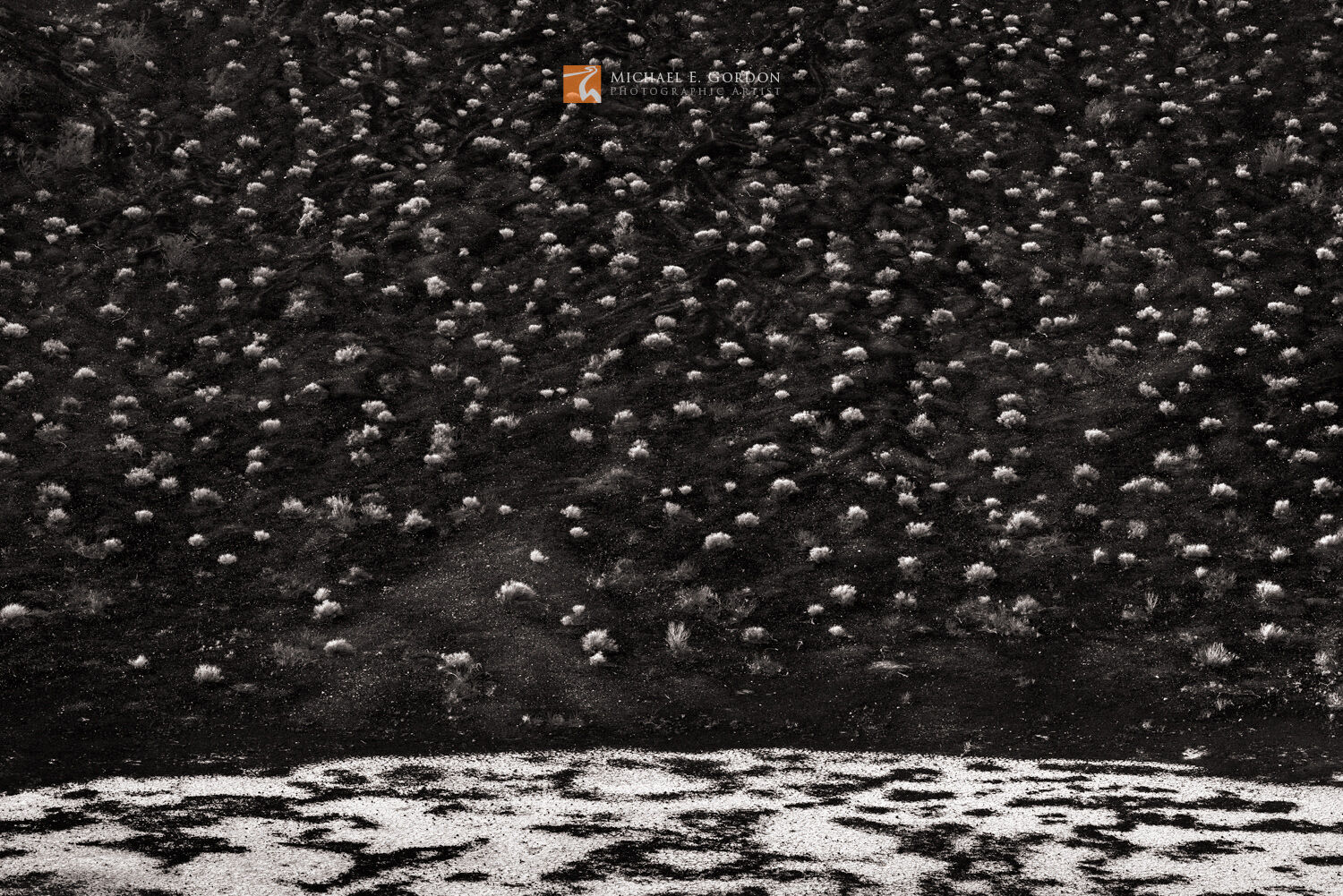
A Death Valley dry lake bed (playa) and steep shrub-filled slope resemble a sporting arena and seating.
Found in Death Valley is a geologic feature known as a maar; a broad, low-relief volcanic crater created by an eruption which occurred when magma met subterranean groundwater. I was terribly fascinated by this place when I first began to explore and photograph its unique terrain. The walk I most often take is on high ground with stupendous views in every direction, and despite the violent nature of its origin, the volcanic landscape is smooth and sensual like a sand dune, and its dynamic undulating terrain lends itself to an enchanting unfolding of morning light (which changes on a near daily basis to the experienced observer). Only through repeated visits would I ever begin to understand the nuances of this place and its light, to see beyond the obvious photographs while identifying the potential for my own unique concepts. What I also found fascinating was that although Death Valley National Park draws many photographers each year, few ever see or really photograph this location.
"Trust that little voice in your head that says 'Wouldn't it be interesting if . . .’ And then do it."
Duane Michals
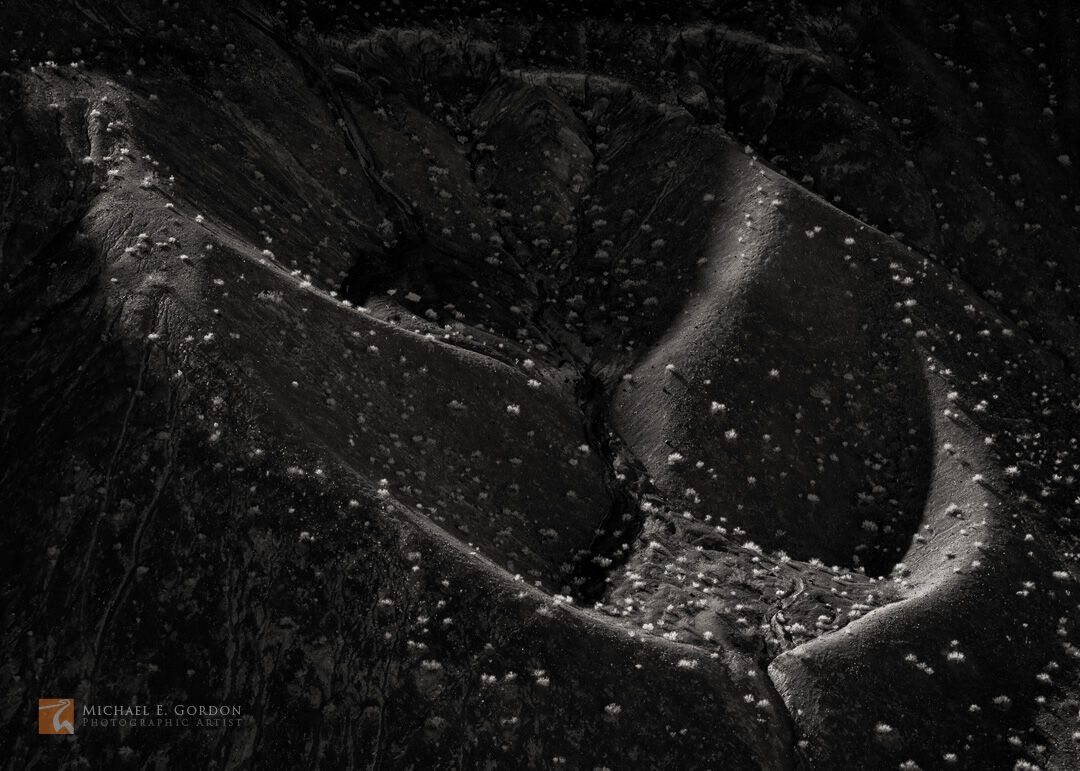
Portions of Death Valley are shocking facsimiles for many of the images I had seen from the Mars Curiosity rover and from Moon missions. Not only has it served as countless planets and fictional locations in scores of television shows and motion pictures, NASA conducted rover research and testing here. I began to realize the otherworldly possibilities for my camera. One quiet morning here, when my geological and creative minds effectively collaborated, the concept came to me: Life on Maars. This Death Valley maar may look a lot like another planet, yet it bears life and is discretely dressed in unique luminous plants. By using the abstract qualities of the black and white medium and by eliminating references to horizon and scale - and by highlighting the glowing plants amidst their fascinating geological landscape - viewers of my photographs are required to slow down, to observe carefully, and to bring a piece of themselves to the image. Could there be anything better?